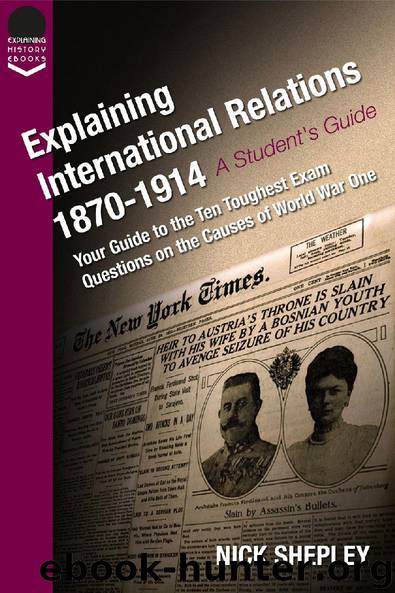
Explaining International Relations 1870-1914 by Nick Shepley
Author:Nick Shepley
Language: eng
Format: epub
Tags: First World War, Bismarck, Disraeli, Congress of Berlin, Scramble for Africa, Balkan Crisis, Kaiser, Franco Prussian War, Morocco Crisis, Dreadnought Race, July Crisis, Balkan Wars
ISBN: 9781785382390
Publisher: Andrews UK Limited 2015
Published: 2015-07-15T00:00:00+00:00
Question 9
How did the crises over Morocco change European affairs?
The signing of the Entente Cordiale came as a shock to the Kaiser and to Germany’s diplomats. No longer was France isolated on the continent and the British, who had previously shied away from continental affairs, were now becoming increasingly involved. The Kaiser argued that Germany should re-kindle its relationship with Russia, and he enjoyed a closer personal relationship with Tsar Nicholas II, his cousin.
The Tsar, by the summer of 1905 was struggling to hold on to his crown, the disastrous war he had provoked with Japan had led to the loss of two fleets and nearly 300,000 men killed, wounded or captured. Russia had been shaken by revolution in 1905 following a massacre of workers outside the Winter Palace in January and the Tsar was open to any friends he might be able to cultivate.
The two men sailed on their respective royal yachts to Bjorko in the Gulf Of Finland and moored them side to side as they discussed a possible alliance. The Kaiser persuaded the Tsar to sign a treaty with Germany, convincing his naive and impressionable cousin that the British and French could not be trusted, even though France was an ally of Russia.
When the Tsar returned to Russia and explained to his diplomats what he had done, he was over-ruled by them. They were shocked and outraged that he had taken such a reckless decision to effectively annul the terms of the Franco-Russian Treaty. France had no intention of accepting any form of understanding between Russia and Germany whilst remaining in an alliance with Moscow. This meant that any hope the Kaiser had of breaking Germany’s growing diplomatic crisis could not be done by developing a relationship with Russia, so a westward strategy was required instead and the Entente Cordiale presented the Kaiser with an opportunity, or so he thought, to push the new friendship to breaking point.
In January 1905 the French sent envoys to the Sultan of Morocco to announce their intention to extend their control over the country. French involvement in Morocco dated back decades, as did their formal control over Algeria (1830) and Tunisia (1881). France demanded control over the Moroccan police and army, but the Sultan refused. The other powers that had an interest in Morocco in particular and North Africa in General were Spain and Italy and both were offered concessions in order to smooth the way for France’s acquisition of the country. The Kaiser, who expected to be consulted on all international issues in recognition of Germany’s status as a world power, was ignored. An international agreement in 1881 had stipulated that the status of Morocco could not be changed without the involvement of all the great powers, so France presented the Kaiser with an opportunity by a deliberate policy of provocation. The Kaiser was less interested in the nuances of international law and more concerned with demonstrating to the French that their new British friends were unreliable. His diplomats had told him that the British were less than keen to intervene on behalf of France in its dispute.
Download
This site does not store any files on its server. We only index and link to content provided by other sites. Please contact the content providers to delete copyright contents if any and email us, we'll remove relevant links or contents immediately.
| Africa | Americas |
| Arctic & Antarctica | Asia |
| Australia & Oceania | Europe |
| Middle East | Russia |
| United States | World |
| Ancient Civilizations | Military |
| Historical Study & Educational Resources |
Room 212 by Kate Stewart(5119)
The Crown by Robert Lacey(4814)
Endurance: Shackleton's Incredible Voyage by Alfred Lansing(4780)
The Iron Duke by The Iron Duke(4354)
The Rape of Nanking by Iris Chang(4211)
Joan of Arc by Mary Gordon(4109)
Killing England by Bill O'Reilly(4001)
Say Nothing by Patrick Radden Keefe(3983)
I'll Give You the Sun by Jandy Nelson(3445)
Shadow of Night by Deborah Harkness(3366)
Hitler's Monsters by Eric Kurlander(3341)
Mary, Queen of Scots, and the Murder of Lord Darnley by Alison Weir(3210)
Blood and Sand by Alex Von Tunzelmann(3203)
Eleanor & Park by Rainbow Rowell(3169)
Darkest Hour by Anthony McCarten(3129)
Margaret Thatcher: The Autobiography by Thatcher Margaret(3081)
Book of Life by Deborah Harkness(2937)
Red Famine: Stalin's War on Ukraine by Anne Applebaum(2932)
The One Memory of Flora Banks by Emily Barr(2863)
